
Five questions to answer before Day One
A response to PwC's 2026 M&A Integration Survey
Richard Parry
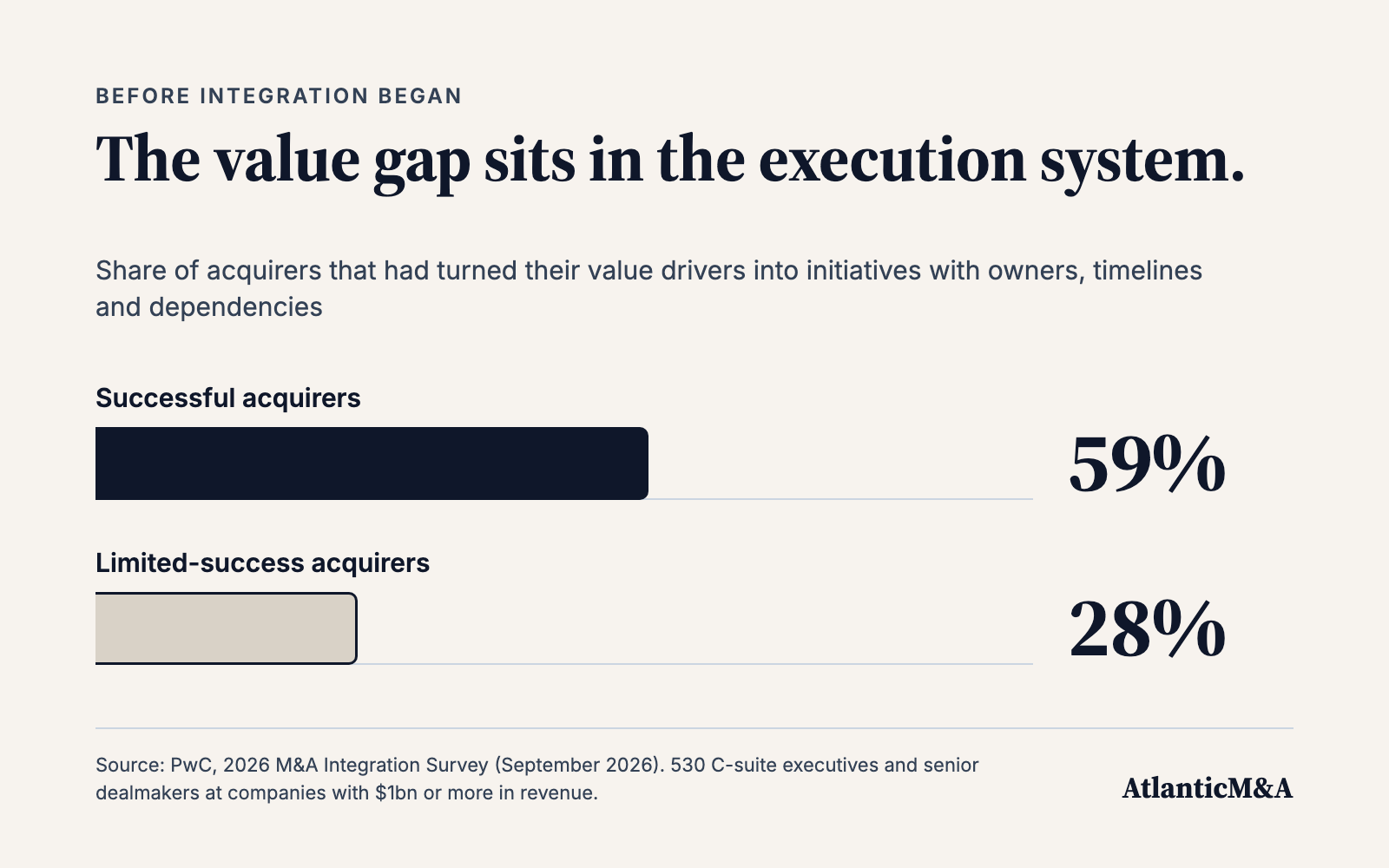
PwC's 2026 M&A Integration Survey gives a short answer to why most deals fall short: leaders leave the operating decisions behind the deal thesis unresolved until after close. Only about one in three acquirers fully achieved their thesis objectives. Successful acquirers were about twice as likely to have turned their value drivers into owned, timed initiatives before integration began: 59% against 28%.
PwC closes with a CEO agenda of five questions. They are the right ones. Here is how we work through them with a client, ideally before the deal closes.
- What is the deal thesis, as two or three measurable outcomes? We write it down with the deal team and the operating leaders, in the client's own words, and attach a baseline to each outcome.
- Which three or four changes deliver those outcomes, and what must be protected? We sort the work into what changes, what is protected, what is integrated and what waits for more information. The protect list often matters most: the people, customers and products that made the target worth buying.
- Which leadership, talent, customer, technology, tax and regulatory decisions must be settled before Day One? Only 16% of acquirers assess leadership and talent before signing. We put people decisions on the same footing as commercial and technology ones.
- Who owns each value initiative, with what funding and authority? Every initiative gets a named owner, a date, its dependencies and the conditions that could stop it.
- What will let the CFO, board and investors see realised value rather than activity? Only 27% of limited-success acquirers are very confident their reported synergies are real and auditable, against 62% of successful ones. We set the baseline and the validation rules before the first number is reported.
PwC surveyed companies with $1 billion or more in revenue. In my experience the same questions apply to smaller deals, with fewer people to answer them.
Why we run it on a system
Answers to these questions usually end up in a deck. Then the deck drifts from the plan, and the plan from the numbers. We run every engagement on atlanticma.ai, the Agentic Transformation OS, so the thesis, the initiatives, the owners and the measured value stay connected from before close to the end of the programme.
McKinsey estimated in September that agents can cut the time spent on many core transformation tasks by 35 to 40 percent. We spend that time on the decisions and the proof, not on building slides.
When we leave, the client keeps the system, the plan and its history. The method stays with the company that has to live with the result.
How we work
Senior practitioners deliver every engagement, and a partner oversees each one. The record lives in the system, and what it produces comes out as slides: the steering committee pack and the status reports the client's people already work from. So the programme fits the way their teams already work, rather than asking them to learn ours.
As CTrO of a PE-backed life sciences platform, I integrated nine acquisitions into one company across three continents in two years.
If you have a deal approaching signing, talk to us about the decisions to settle before Day One.
Richard Parry, Founder, AtlanticM&A